 |
JS8Call-Improved master
|
Conservative coherent 8-FSK likelihood support for the JS8 decoder. More...
#include <algorithm>#include <array>#include <cmath>#include <complex>#include <cstddef>#include <cstdlib>#include <limits>#include <numbers>#include <optional>#include <vector>
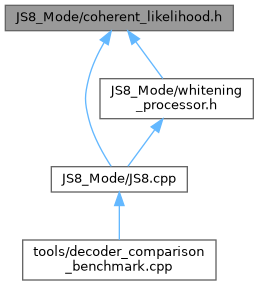
Go to the source code of this file.
Classes | |
| struct | js8::CoherentPilot |
| struct | js8::CoherentDataSymbol |
| struct | js8::CarrierPhaseFit |
| Result of the low-order carrier-phase fit over pilot symbols. More... | |
| struct | js8::CoherentLikelihoodTelemetry |
| Debug/benchmark telemetry for one candidate frame. More... | |
| struct | js8::CoherentToneResult |
| struct | js8::CoherentBlend< ToneRows, DataSymbols > |
Namespaces | |
| namespace | js8 |
| JS8 namespace for Kalman filter-based trackers. | |
Functions | |
| double | js8::detail::wrapPhase (double angle) |
| bool | js8::detail::solveWeightedLine2 (const double *x0, const double *x1, const double *y, const double *w, std::size_t n, double &a, double &b) |
| double | js8::effectiveSymbolTimeSeconds (double baseTimeSeconds, double shiftSamples, double sampleRateHz) |
| std::complex< double > | js8::normalizeFrequencyTrackerPhase (std::complex< double > bin, double trackerHz, double sampleRateHz, int windowSamples) |
| std::complex< double > | js8::normalizeTimingPhase (std::complex< double > bin, int tone, double shiftSamples, int windowSamples) |
| CarrierPhaseFit | js8::fitCarrierPhase (std::vector< CoherentPilot > const &pilots, int minPilots, double minSpanSeconds, int windowSamples, double sampleRateHz) |
| double | js8::coherentBlendWeight (CarrierPhaseFit const &fit) |
| double | js8::predictCarrierPhase (CarrierPhaseFit const &fit, double timeSeconds) |
| Predicted carrier phase at an absolute symbol-start time. | |
| template<std::size_t Tones> | |
| bool | js8::blendToneScores (std::array< float, Tones > const &noncoherent, std::array< float, Tones > const &coherent, float alpha, std::array< float, Tones > &out) |
| template<std::size_t Tones> | |
| std::optional< double > | js8::topTwoMargin (std::array< float, Tones > const &scores) |
| Margin between the largest and second-largest tone scores, if well-defined. | |
| CoherentToneResult | js8::computeCoherentToneScores (std::vector< CoherentPilot > const &pilots, std::vector< CoherentDataSymbol > const &data, int minPilots, double minSpanSeconds, int windowSamples, double sampleRateHz) |
Conservative coherent 8-FSK likelihood support for the JS8 decoder.
The JS8 waveform is phase-continuous: over one symbol the tone-dependent phase term accumulates exactly 2*pi*tone radians, so every symbol-start FFT bin for the transmitted tone shares a common carrier phase (mod 2*pi). This header fits that carrier phase trajectory from the known Costas pilot symbols and converts complex data-symbol tone bins into coherent tone numerators.
Phase frame: the decoder's FrequencyTracker and TimingTracker perturb the complex bins deterministically (see normalizeFrequencyTrackerPhase() and normalizeTimingPhase()). Every observation is divided back into one consistent nominal-boundary phase frame before fitting or scoring. The trackers themselves are never modified.
Likelihood units: with complex noise variance sigma^2 = toneNoise * symbolNoise (the WhiteningProcessor convention), the tone-dependent part of the coherent log likelihood for a known amplitude A is (A*projection - 0.5*A*A) * invSigma2, where projection = Re(bin * exp(-j*phase)). The decoder multiplies the numerators produced here by its own per-symbol invSigma2 and blends them with the legacy 0.5*power*invSigma2 scores. No symbol is ever normalized independently, so symbol reliability information is preserved.
Design constraints (see decoder integration):
 1.16.1